Our website uses cookies. Please note that by continuing to use our website, you are consenting to the use of these cookies. For more information, please refer to our Privacy policy.
How to Decide Between Refactoring, Rebuilding, or Re-Architecting a Legacy System
March 30, 2026

What is the real cost when software architecture limits the ability to pivot, scale, or innovate? For technical leaders, architectural modernization is essential to unlock growth potential and to protect the competitive position.
Software rarely fails in obvious ways. Most platforms keep running, users stay active, and revenue continues to flow long after structural problems have begun to build beneath the surface. The issue hardly manifests as an outage or critical failure; it emerges gradually, through a slow loss of adaptability.
Delivery cycles go beyond their previous rhythm; features that once required modest effort now demand broader coordination across teams; integrations become increasingly sensitive to change; and even well-understood components begin to feel risky to modify. Engineers spend more time navigating dependencies than building new capabilities. Leadership conversations shift from innovation to caution.
At this stage, the system still functions. What has changed is its responsiveness to growth, which is often first visible in measurable indicators such as increased feature lead times, rising change failure rates, or escalating cost per feature delivered. When the average time to deploy new functionality exceeds established baselines, or the effort required to implement routine changes noticeably increases, these metrics deliver an early, objective signal that the architecture is struggling to keep pace with business demands.
This moment marks a structural inflection point. The organization is no longer evaluating code quality alone; it is confronting whether the architecture can sustain the next phase of evolution. The question that follows is not simple: should the company refactor what it has, rebuild from scratch, or re-architect the system to support long-term scalability?
The decision is strategic since each path addresses a different category of constraint, and the consequences of misalignment unfold gradually.
How Growth Exposes Architectural Boundaries
Most platforms are designed with their early-stage priorities in mind. Speed of execution dominates architectural rigor, a monolithic structure simplifies deployment, and tightly coupled components accelerate iteration. Infrastructure is optimized for immediate performance rather than elastic expansion.
These decisions are rational and enable teams to move quickly, validate product-market fit, and establish operational stability.
As organizations scale, however, the environment changes. Features accumulate, teams expand, and integrations multiply. Enterprise requirements introduce compliance, security, and data governance considerations that were not part of the original design assumptions. Artificial intelligence initiatives demand structured data access and predictable latency, and cloud cost optimization becomes a board-level concern.
Under these pressures, architectural boundaries begin to surface.
A system built for early-stage agility may not support mid-stage complexity without friction. As coordination costs increase, deployment pipelines become sensitive to cross-domain changes, infrastructure cost curves steepen, and innovation slows not because the organization lacks ideas, but because the platform resists adaptation.
Recognizing this shift requires distinguishing between localized technical debt and systemic architectural limitations. The response depends on that diagnosis.
To translate this distinction into practical action, teams can use a simple self-diagnosis checklist. Ask:
- If we handled the immediate pain points tomorrow, would delivery stay smooth for several more feature cycles?
- Do the same classes of problems appear in multiple, unrelated parts of the system?
- Are deployment delays or reliability issues caused by high levels of cross-team coordination or architectural coupling?
If you answer "no" to the first question and "yes" to either of the next two, your challenges may be in broader structural boundaries rather than isolated technical debt. This quick test can clarify whether incremental fixes are enough or if larger architectural evolution is necessary.
Refactoring a Legacy System: When Incremental Evolution Is Sufficient
Refactoring focuses on improving internal code quality while preserving external behavior. It reorganizes modules, clarifies domain logic, improves test coverage, and eliminates redundant or fragile patterns.
When the system’s architecture stays fundamentally aligned with business direction, refactoring can restore delivery efficiency without structural disruption. It allows organizations to address accumulated technical debt incrementally while preserving institutional knowledge embedded in the codebase.
Refactoring is often appropriate when:
- Performance bottlenecks are localized rather than systemic.
- Code inconsistencies hinder maintainability, but architectural boundaries remain valid.
- Infrastructure scales adequately, though internal organization requires discipline.
- The business model is stable and does not need considerable structural adaptation.
In such cases, disciplined refactoring can meaningfully extend a platform's lifespan. It strengthens the foundation without altering its design assumptions.
Its effectiveness, however, is bound by those assumptions. Refactoring enhances clearness and maintainability, yet it does not redefine architectural relationships. If friction results from domain coupling, deployment rigidity, or growing constraints embedded in the system’s structure, incremental cleanup may provide temporary relief but not restore long-term adaptability.
Understanding this limitation is essential. Refactoring is powerful when applied within the right context, but it is not a structural redesign.
When Rebuilding Software from Scratch Becomes Justifiable
A full rebuild replaces the system entirely, enabling the redefinition of architecture, the adoption of modern technologies, and the alignment of structural assumptions with current business realities.
Rebuilding becomes strategically defensible when:
- The technology stack is obsolete or unsupported.
- Security or compliance risks are inherent to legacy frameworks.
- Architectural assumptions fundamentally conflict with the organization’s future direction.
- Maintenance costs outweigh the strategic value of incremental evolution.
- The business model has shifted so significantly that existing domain boundaries no longer reflect operational reality.
Rebuilding offers clarity and structural freedom. It allows organizations to re-express domain logic, redesign infrastructure for current scale, and integrate modern paradigms without inherited limitations.
Yet rebuilding introduces complexity and risk. It requires sustained capital investment, parallel maintenance of legacy systems during transition, and disciplined architectural governance to avoid repeating past design shortcomings under a new technology stack. Institutional knowledge embedded in the existing system may be partially lost, especially in mature platforms that have evolved over years of domain refinement.
Rebuilding is a complete transformation initiative that changes the structural baseline of the organization’s digital infrastructure. It should be undertaken with explicit strategic alignment rather than reactive urgency.
Re-Architecting for Scalability and Structural Resilience
Between incremental refactoring and full reconstruction lies a third approach: re-architecting.
Re-architecting preserves the core domain logic that continues to generate value while reshaping structural boundaries to reduce systemic friction. It recognizes that the system contains strategic assets worth maintaining, even if its organization no longer supports growing complexity.
This path is often relevant when:
- The technology stack is still viable.
- The core business model is stable.
- Domain logic is mature and strategically accurate.
- Growth introduces friction mainly through coupling, integration complexity, or deployment rigidity.
Re-architecting may involve decomposing a monolith into modular domains, introducing event-driven communication patterns, separating read and write models, migrating toward cloud-native infrastructure, or redefining service boundaries to reflect changing business contexts.
Unlike refactoring, these changes alter structural relationships. Unlike rebuilding, they preserve operational continuity.
Because re-architecting reshapes internal boundaries as maintaining live operations, it demands architectural clarity, disciplined sequencing, and strong governance. Poorly managed transitions risk creating hybrid states that increase complexity rather than reduce it.
When executed thoughtfully, however, re-architecting restores structural adaptability without discarding accumulated business logic. It extends the lifespan of strategic assets while enabling scalable growth.
Evaluating Your Modernization Strategy: A Structured Approach
Choosing between refactoring, rebuilding, and re-architecting requires examining more than technical metrics. The evaluation must consider the structural alignment between the architecture and the business trajectory. Several dimensions deserve careful analysis:
Growth Trajectory
If the projected scale can be absorbed within existing structural assumptions through incremental improvements, refactoring may suffice. If scaling introduces nonlinear operational strain or integration fragility, systemic evolution becomes more plausible.
Domain Stability
When core business logic remains stable, preserving and strengthening the current system may be rational. If the organization is undergoing product pivots, regulatory transformation, or introducing a new revenue model, rebuilding may deliver clearer structural alignment.
Integration Density
Expanding ecosystems often bring in complex API dependencies, analytics layers, and automation frameworks. When integration fragility begins to constrain innovation, architectural decoupling may become strategically necessary.
Infrastructure Economics
Rising cloud expenses, inefficient deployment workflows, and escalating operational overhead frequently indicate that infrastructure complexity is compounding faster than capability.
Organizational Readiness
Modernization initiatives require architectural governance and disciplined execution. Without these capabilities, even the correct tactical choice can stumble in implementation.
A disciplined evaluation clarifies which constraint most directly limits adaptability.
Modernization Decision Matrix
Below is a simplified structural lens that organizations can use to clarify their direction:
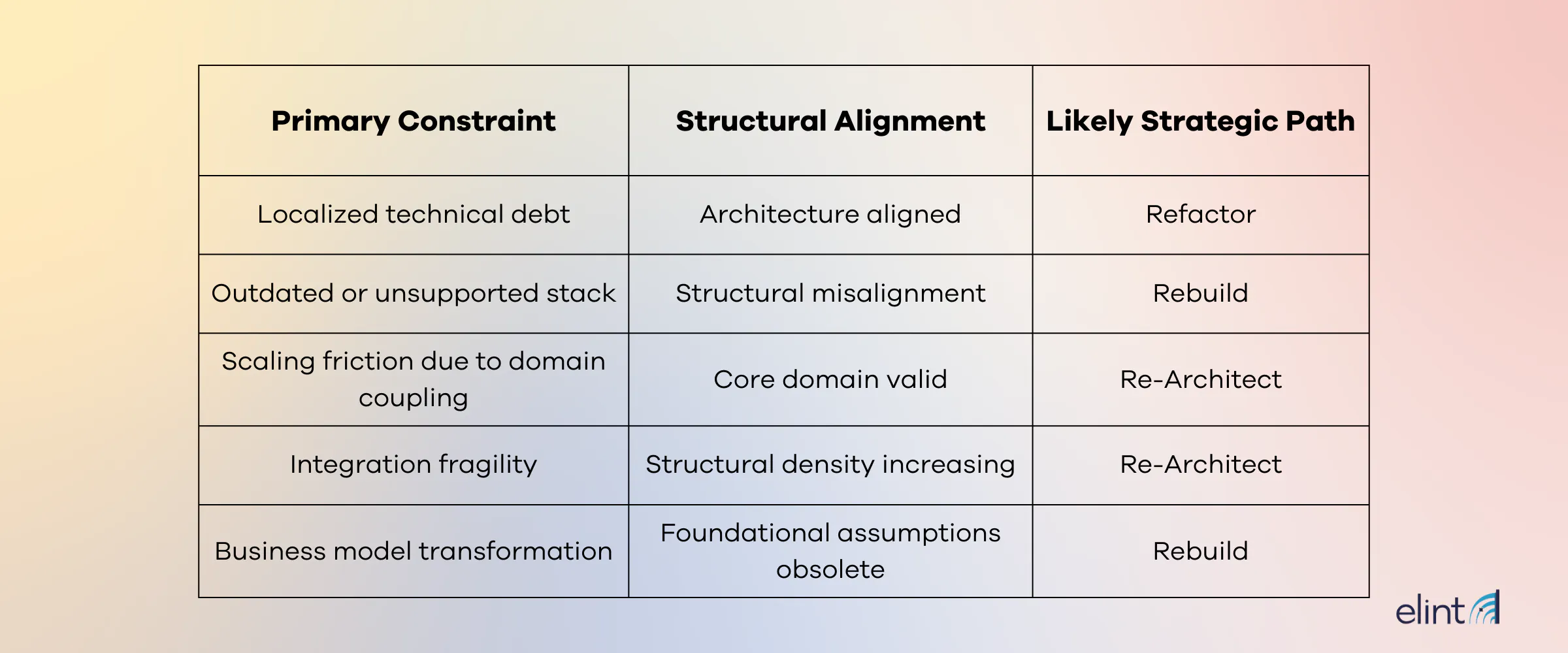
It is important to note that this matrix does not prescribe a universal answer. It reframes the decision around structural alignment rather than emotional reaction to technical discomfort.
Risks of Choosing the Wrong Modernization Path
Modernization decisions rarely fail immediately when misaligned. Systems continue to operate, and teams continue to deliver. The cost manifests gradually. For example, feature lead times may increase from two weeks to over a month within 18 months, or deployment frequency could quietly decline as release coordination becomes more complex. Teams may find that what once took hours now absorbs days of effort. These subtle shifts accumulate, making the hidden cost of architectural misalignment visible only in hindsight.
Extending refactoring beyond structural relevance can generate incremental improvements while more profound constraints persist. Rebuilding prematurely can redirect capital and leadership focus away from product momentum. Re-architecting without disciplined sequencing can create transitional instability that compounds operational risk.
In each case, the underlying consequence is erosion of strategic agility. Innovation slows, costs rise incrementally, integration flexibility diminishes, and competitive responsiveness weakens.
Because these effects accumulate over time, modernization should be framed as a strategic investment decision rather than a technical correction.
Modernizing Software as a Strategic Capability
Organizations whose revenue and operations depend on software must treat structural change as a continuous capability rather than an occasional repair.
As systems mature, architectural discipline becomes inseparable from financial discipline. Deployment efficiency influences operating margins. Infrastructure elasticity affects scalability economics. Structural clarity determines how rapidly innovation can translate into market advantage.
The decision to refactor, rebuild, or re-architect raises a broader question: Does the current system architecture support the organization’s growth ambitions?
There is no universally correct path. The appropriate strategy depends on context, risk tolerance, capital allocation, and long-term vision.
What remains constant is the need for structural alignment between architecture and trajectory.
When systems become difficult to evolve, the most important step is not instant intervention, but disciplined diagnosis. Clarity precedes action. And within environments where software underpins competitive advantage, structural clarity is often the defining factor between incremental continuity and scalable expansion.
Final Thoughts
If your platform has become harder to evolve than it should be, the underlying issue may go beyond code quality or performance tuning. Structural alignment between architecture and ambition determines whether growth compounds or stalls.
Modernization begins with understanding which constraint truly limits progress and selecting the intervention that restores adaptability without introducing unnecessary risk.
In complex software environments, disciplined architectural evaluation is foundational to sustainable growth.